Saturday, 20 August 2016

Friday, 29 July 2016
How to add custom fonts in Jasper of GGTS
Hi,
Before going to add, first download any one of the font from google. i downloaded one of the font from http://www.1001freefonts.com/
goto your project workspace,
Step 1: Add Font in Jasper
windows -> prefferences -> jaspersoft studio -> Fonts -> Add
place family name as font name
browse true type as font file
check the checkbox of Embed this font in PDF doucment
and click Finish and then OK

Step 2: Create jar file of given font through iReport Designer tool
install and run iReport Designer tool
goto tools -> options -> iReport -> Fonts
Click Install Font,

Browse font location and then click next
place family name as font name
check the checkbox of Embed this font in PDF doucment

and then click Finish
the given font showed in Fonts tab
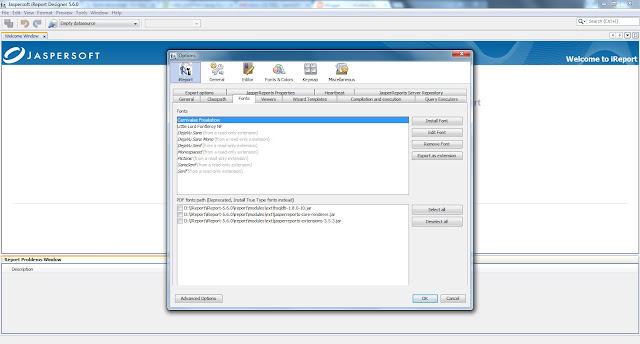
select that font, click on Export as extension

Save with .jar, then jar is saved in selected location.
then close iReport Designer.
Step 3: Add jar file to GGTS
add jar file in lib folder of ggts
place these 3 lines before calling jasper report
String defaultPDFFont = "LittleLordFontleroyNF";
DefaultJasperReportsContext context = DefaultJasperReportsContext.getInstance();
JRProperties.setProperty("net.sf.jasperreports.awt.ignore.missing.font", "true");
JRProperties.setProperty("net.sf.jasperreports.default.font.name", defaultPDFFont);

extract jar file in outside folder. it showing as follows.

copy the font name which is placed in fonts/fontsfamily1469773845547.xml

place this font name at defaultPDFFont of above groovy code
run project take pdf.
Thank You
Before going to add, first download any one of the font from google. i downloaded one of the font from http://www.1001freefonts.com/
goto your project workspace,
Step 1: Add Font in Jasper
windows -> prefferences -> jaspersoft studio -> Fonts -> Add
place family name as font name
browse true type as font file
check the checkbox of Embed this font in PDF doucment
and click Finish and then OK

Step 2: Create jar file of given font through iReport Designer tool
install and run iReport Designer tool
goto tools -> options -> iReport -> Fonts
Click Install Font,

Browse font location and then click next
place family name as font name
check the checkbox of Embed this font in PDF doucment

and then click Finish
the given font showed in Fonts tab

select that font, click on Export as extension

Save with .jar, then jar is saved in selected location.
then close iReport Designer.
Step 3: Add jar file to GGTS
add jar file in lib folder of ggts
place these 3 lines before calling jasper report
String defaultPDFFont = "LittleLordFontleroyNF";
DefaultJasperReportsContext context = DefaultJasperReportsContext.getInstance();
JRProperties.setProperty("net.sf.jasperreports.awt.ignore.missing.font", "true");
JRProperties.setProperty("net.sf.jasperreports.default.font.name", defaultPDFFont);

extract jar file in outside folder. it showing as follows.

copy the font name which is placed in fonts/fontsfamily1469773845547.xml

place this font name at defaultPDFFont of above groovy code
run project take pdf.
Thank You
Tuesday, 26 July 2016
Improve the performance of GGTS
for improving the performance of ggts, increase the permsize of JVM.
goto -> window -> preferences -> Java -> Installed JREs
select the jdk file then click on edit, place the given values in VM arguments
-XX:PermSize=256m -XX:MaxPermSize=752m
then click Finish and then OK

goto -> window -> preferences -> Java -> Installed JREs
select the jdk file then click on edit, place the given values in VM arguments
-XX:PermSize=256m -XX:MaxPermSize=752m
then click Finish and then OK

Thursday, 21 July 2016
Spring CRUD Operations in Eclipse
Hi,
Before going to crude operations first set up the project with spring security as follows.
Spring Project setup in Eclipse
the flow is


Welcome.jsp
<%@ page language="java" contentType="text/html; charset=ISO-8859-1"
pageEncoding="ISO-8859-1"%>
<!DOCTYPE html PUBLIC "-//W3C//DTD HTML 4.01 Transitional//EN" "http://www.w3.org/TR/html4/loose.dtd">
<html>
<head>
<meta http-equiv="Content-Type" content="text/html; charset=ISO-8859-1">
<title>Insert title here</title>
</head>
<body>
<h1>Hi This is welcome page...!</h1>
<a href="employee.html">Employee</a>
<a href="<%=request.getContextPath()%>/j_spring_security_logout"> Logout</a>
</body>
</html>
Employee.java:
package com.vamsi.model;
import javax.persistence.Column;
import javax.persistence.Entity;
import javax.persistence.GeneratedValue;
import javax.persistence.GenerationType;
import javax.persistence.Id;
import javax.persistence.Table;
@Entity
@Table(name="employee")
public class Employee {
@Id
@GeneratedValue(strategy = GenerationType.AUTO)
@Column(name="employeeId")
private Long employeeId;
@Column(name="name")
private String name;
public Long getEmployeeId() {
return employeeId;
}
public void setEmployeeId(Long employeeId) {
this.employeeId = employeeId;
}
public String getName() {
return name;
}
public void setName(String name) {
this.name = name;
}
}
EmployeeController.java:
package com.vamsi.controller;
import java.util.HashMap;
import java.util.Map;
import org.springframework.beans.factory.annotation.Autowired;
import org.springframework.stereotype.Controller;
import org.springframework.web.bind.annotation.ModelAttribute;
import org.springframework.web.bind.annotation.RequestMapping;
import org.springframework.web.bind.annotation.RequestMethod;
import org.springframework.web.servlet.ModelAndView;
import com.vamsi.model.Employee;
import com.vamsi.service.EmployeeService;
@Controller
public class EmployeeController {
@Autowired
EmployeeService employeeService;
@RequestMapping(value = "/employee", method = RequestMethod.GET)
public ModelAndView addEmployee(@ModelAttribute("command") Employee employee) {
Map<String, Object> model = new HashMap<String, Object>();
model.put("employee", employee);
model.put("employeeList", employeeService.getEmployees());
return new ModelAndView("/employee/index", model);
}
@RequestMapping(value = "/employeeSave", method = RequestMethod.POST)
public ModelAndView employeeSave(@ModelAttribute("command") Employee employee) {
employeeService.addEmployee(employee);
return new ModelAndView("redirect:/employee.html");
}
@RequestMapping(value = "/employeeDelete", method = RequestMethod.GET)
public ModelAndView deleteEmployee(@ModelAttribute("command") Employee employee){
employeeService.deleteEmployee(employee);
return new ModelAndView("redirect:/employee.html");
}
@RequestMapping(value = "/employeeEdit", method = RequestMethod.GET)
public ModelAndView editEmployee(@ModelAttribute("command") Employee employee){
Map<String, Object> model = new HashMap<String, Object>();
model.put("employee", employeeService.getEmployee(employee.getEmployeeId()));
model.put("employeeList", employeeService.getEmployees());
return new ModelAndView("/employee/index", model);
}
}

after run the app the frames as follows:
Login:
 After login, welcome page as follows:
 Click on Employee, we will navigate to manage employees. here we will do crud operations.

Thank You
Before going to crude operations first set up the project with spring security as follows.
Spring Project setup in Eclipse
the flow is
- generate request from JSP
- the request passed to controller then it send to service then go to dao
- processing the data at dao and then return back to JSP
JSP -> Controller -> Service -> Dao
After login the welcome page should like this

Welcome page and structure of project given below check once.

Welcome.jsp
<%@ page language="java" contentType="text/html; charset=ISO-8859-1"
pageEncoding="ISO-8859-1"%>
<!DOCTYPE html PUBLIC "-//W3C//DTD HTML 4.01 Transitional//EN" "http://www.w3.org/TR/html4/loose.dtd">
<html>
<head>
<meta http-equiv="Content-Type" content="text/html; charset=ISO-8859-1">
<title>Insert title here</title>
</head>
<body>
<h1>Hi This is welcome page...!</h1>
<a href="employee.html">Employee</a>
<a href="<%=request.getContextPath()%>/j_spring_security_logout"> Logout</a>
</body>
</html>
Employee.java:
package com.vamsi.model;
import javax.persistence.Column;
import javax.persistence.Entity;
import javax.persistence.GeneratedValue;
import javax.persistence.GenerationType;
import javax.persistence.Id;
import javax.persistence.Table;
@Entity
@Table(name="employee")
public class Employee {
@Id
@GeneratedValue(strategy = GenerationType.AUTO)
@Column(name="employeeId")
private Long employeeId;
@Column(name="name")
private String name;
public Long getEmployeeId() {
return employeeId;
}
public void setEmployeeId(Long employeeId) {
this.employeeId = employeeId;
}
public String getName() {
return name;
}
public void setName(String name) {
this.name = name;
}
}
EmployeeController.java:
package com.vamsi.controller;
import java.util.HashMap;
import java.util.Map;
import org.springframework.beans.factory.annotation.Autowired;
import org.springframework.stereotype.Controller;
import org.springframework.web.bind.annotation.ModelAttribute;
import org.springframework.web.bind.annotation.RequestMapping;
import org.springframework.web.bind.annotation.RequestMethod;
import org.springframework.web.servlet.ModelAndView;
import com.vamsi.model.Employee;
import com.vamsi.service.EmployeeService;
@Controller
public class EmployeeController {
@Autowired
EmployeeService employeeService;
@RequestMapping(value = "/employee", method = RequestMethod.GET)
public ModelAndView addEmployee(@ModelAttribute("command") Employee employee) {
Map<String, Object> model = new HashMap<String, Object>();
model.put("employee", employee);
model.put("employeeList", employeeService.getEmployees());
return new ModelAndView("/employee/index", model);
}
@RequestMapping(value = "/employeeSave", method = RequestMethod.POST)
public ModelAndView employeeSave(@ModelAttribute("command") Employee employee) {
employeeService.addEmployee(employee);
return new ModelAndView("redirect:/employee.html");
}
@RequestMapping(value = "/employeeDelete", method = RequestMethod.GET)
public ModelAndView deleteEmployee(@ModelAttribute("command") Employee employee){
employeeService.deleteEmployee(employee);
return new ModelAndView("redirect:/employee.html");
}
@RequestMapping(value = "/employeeEdit", method = RequestMethod.GET)
public ModelAndView editEmployee(@ModelAttribute("command") Employee employee){
Map<String, Object> model = new HashMap<String, Object>();
model.put("employee", employeeService.getEmployee(employee.getEmployeeId()));
model.put("employeeList", employeeService.getEmployees());
return new ModelAndView("/employee/index", model);
}
}
EmployeeService.java:
package com.vamsi.service;
import java.util.List;
import com.vamsi.model.Employee;
public interface EmployeeService {
public void addEmployee(Employee employee);
public Employee getEmployee(Long employeeId);
public List<Employee> getEmployees();
public void deleteEmployee(Employee employee);
}
EmployeeServiceImp.java:
package com.vamsi.service;
import java.util.List;
import org.springframework.beans.factory.annotation.Autowired;
import org.springframework.stereotype.Service;
import com.vamsi.dao.EmployeeDao;
import com.vamsi.model.Employee;
@Service("employeeService")
public class EmployeeServiceImp implements EmployeeService{
@Autowired
EmployeeDao employeeDao;
public void addEmployee(Employee employee) {
// TODO Auto-generated method stub
employeeDao.addEmployee(employee);
}
public Employee getEmployee(Long employeeId) {
// TODO Auto-generated method stub
return employeeDao.getEmployee(employeeId);
}
public List<Employee> getEmployees() {
// TODO Auto-generated method stub
return employeeDao.getEmployees();
}
public void deleteEmployee(Employee employee) {
// TODO Auto-generated method stub
employeeDao.deleteEmployee(employee);
}
}
EmployeeDao.java:
package com.vamsi.dao;
import java.util.List;
import com.vamsi.model.Employee;
public interface EmployeeDao {
public void addEmployee(Employee employee);
public Employee getEmployee(Long employeeId);
public List<Employee> getEmployees();
public void deleteEmployee(Employee employee);
}
EmployeeDaoImp.java:
package com.vamsi.dao;
import java.util.List;
import org.springframework.beans.factory.annotation.Autowired;
import org.springframework.orm.hibernate3.HibernateTemplate;
import org.springframework.stereotype.Repository;
import com.vamsi.model.Employee;
@Repository("employeeDao")
public class EmployeeDaoImp implements EmployeeDao {
@Autowired
HibernateTemplate hibernateTemplate;
public void addEmployee(Employee employee) {
// TODO Auto-generated method stub
hibernateTemplate.saveOrUpdate(employee);
}
public Employee getEmployee(Long employeeId) {
// TODO Auto-generated method stub
return hibernateTemplate.get(Employee.class, employeeId);
}
public List<Employee> getEmployees() {
// TODO Auto-generated method stub
return hibernateTemplate.loadAll(Employee.class);
}
public void deleteEmployee(Employee employee) {
// TODO Auto-generated method stub
hibernateTemplate.delete(employee);
}
}
Domain whould be added in sdnext-servlet.xml as follows:

index.jsp:
this is employee management page
<%@ page language="java" contentType="text/html; charset=ISO-8859-1"
pageEncoding="ISO-8859-1"%>
<%@taglib uri="http://www.springframework.org/tags/form" prefix="form"%>
<%@ taglib uri="http://java.sun.com/jsp/jstl/core" prefix="c"%>
<%@ taglib prefix="fmt" uri="http://java.sun.com/jsp/jstl/fmt"%>
<!DOCTYPE html PUBLIC "-//W3C//DTD HTML 4.01 Transitional//EN" "http://www.w3.org/TR/html4/loose.dtd">
<html>
<head>
<meta http-equiv="Content-Type" content="text/html; charset=ISO-8859-1">
<title>Insert title here</title>
</head>
<body>
<h1>Hi I am Employee Index page</h1>
<form:form method="post" action="employeeSave.html">
<input type="hidden" name="employeeId" value="${employee.employeeId }"/>
Name <form:input type="text" path="name" value="${employee.name }"/><button type="submit">Submit</button>
</form:form>
<br/><br/>
<c:if test="${!empty employeeList }">
<table>
<thead>
<tr>
<th>Sno</th>
<th>Name</th>
<th></th>
</tr>
</thead>
<tbody>
<c:forEach items="${employeeList }" var="e">
<tr>
<td><c:out value=" ${e.employeeId }"/></td>
<td><c:out value=" ${e.name }"/></td>
<td><a href="employeeDelete.html?employeeId=${e.employeeId}">Delete</a> <a href="employeeEdit.html?employeeId=${e.employeeId}">Edit</a></td>
</tr>
</c:forEach>
</tbody>
</table>
</c:if>
</body>
</html>
after run the app the frames as follows:
Login:


Thank You
Monday, 4 July 2016
How to call session object in groovy service
def getSession(){
return WebUtils.retrieveGrailsWebRequest().getSession()
}
return WebUtils.retrieveGrailsWebRequest().getSession()
}
Friday, 1 July 2016
How to solve permGen space problem in tomcat server
goto tomcat >> bin >> catalina.bat
add this line in first if
set JAVA_OPTS=-XX:PermSize=256m -XX:MaxPermSize=700m
add this line in first if
set JAVA_OPTS=-XX:PermSize=256m -XX:MaxPermSize=700m
Monday, 27 June 2016
Why this keyword is not applicable in static context
this key word is useful to access current instance of class. static values and methods are common to all instance of classes. so, static never depend on any class. it is common to all instances of classes.
Subscribe to:
Posts (Atom)